White Label SEO Services: 10 Proven Strategies for Agencies
White label SEO services are when an agency outsources SEO work to a third-party provider, then delivers those results to clients under their own brand. The client never knows another company is involved. You take the credit, your provider does the heavy lifting.
Think of it like a restaurant that buys bread from a bakery but serves it as their own. The bread is the same quality, but the experience is fully yours to deliver.
For agencies looking to scale without the overhead of hiring a full in-house SEO team, this model is hard to beat. You expand your service offering, keep your margins healthy, and focus on what you’re actually good at: client relationships and strategy.
Why Agencies Are Turning to White Label SEO
Hiring SEO specialists is expensive. A mid-level SEO manager in the US costs $65,000–$85,000 per year before benefits. Add a content writer, a link builder, and a technical SEO expert, and you’re looking at $250,000+ in annual payroll before you’ve served a single client.
White label SEO services sidesteps all of that. You pay per project or on retainer, scale up when clients come in, and scale back during slower periods. No recruiting, no training, no HR headaches.
According to a 2024 survey by Agency Analytics, 62% of digital agencies now outsource at least one SEO service. That number keeps climbing as competition for talent intensifies and client expectations grow.
The agencies winning in 2026 aren’t necessarily the biggest ones. They’re the ones with the smartest partnerships.
Types of White Label SEO Services
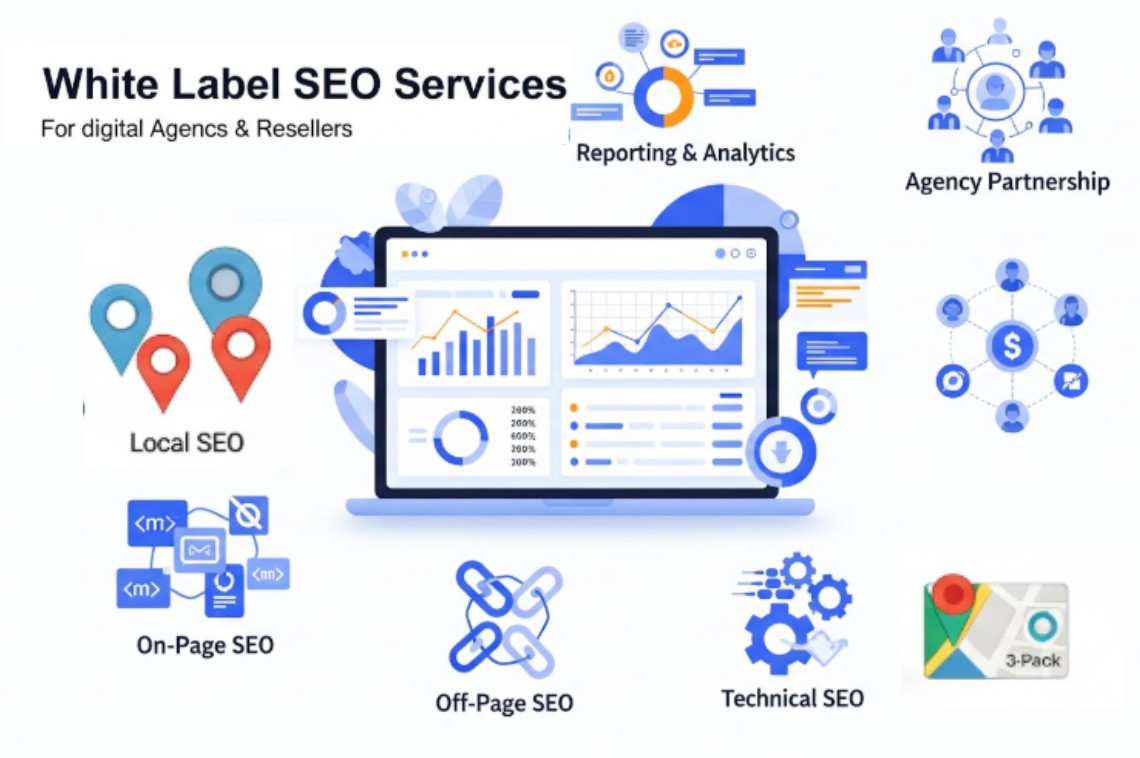
Before you partner with an SEO reseller, you need to understand what’s actually available. Most providers cover four core areas.
On-Page SEO
This covers everything on the client’s website itself: title tags, meta descriptions, header structure, internal linking, keyword placement, and content optimization. Good on-page SEO ensures each page signals its topic clearly to Google without stuffing keywords awkwardly into every sentence.
Off-Page SEO
Off-page SEO is mostly about backlinks. Acquiring editorial links, running blogger outreach campaigns, placing niche edits, and building citations all fall under this category. The quality of your provider’s link building is often what separates a white label seo services partnership that delivers results from one that wastes your client’s budget.
For example, 7thClub’s blogger outreach service connects clients with over 200 high-authority industry websites, placing genuine editorial mentions that actually move rankings rather than link farm placements that can trigger Google penalties.
Technical SEO
Technical SEO deals with crawlability, indexation, site speed, Core Web Vitals, schema markup, canonical tags, and mobile-first optimization. A site with perfect content still struggles to rank if Google can’t crawl and index it efficiently. Technical audits and fixes are often the fastest wins a new client sees.
Local SEO
For businesses targeting specific geographic areas, local SEO is its own discipline. This includes optimizing Google Business Profile, building NAP-consistent business citations, managing reviews, and ranking in the local map pack. Local clients often see results faster than national campaigns, making them great for demonstrating early value.
How to Choose the Right White Label SEO Partner
Your provider’s work goes out under your name. If they cut corners, your reputation takes the hit. So choosing the right SEO reseller is the most critical decision in this entire process.
Here’s what to evaluate:
- Transparency. Will they show you real link reports, real ranking data, and real traffic changes? Any provider that hides their methodology is a red flag.
- White label reporting. You need branded reports your clients see, not generic dashboards with the provider’s logo plastered everywhere. Check what the client-facing deliverables actually look like before signing anything.
- Communication speed. When a client has an urgent issue, how fast does your provider respond? Test their response times during your sales conversations. Slow pre-sale communication predicts slow delivery.
- Link quality standards. Ask specifically how they vet sites for link placement. Real editorial placements on sites with organic traffic are what you want. Avoid providers who talk in vague terms about “high DA links” without specifics.
- Case studies and references. Ask for real examples. Organic traffic growth over 6–12 months. Ranking improvements for competitive terms. Talk to their existing agency partners if possible.
- Scalability. Can they handle 5 clients this month and 50 next year? Growth is the goal, and your provider needs to scale with you.
10 Proven Strategies for Agencies
These aren’t abstract tips. These are strategies working for agencies right now.
1. Start With a Defined Service Package
Don’t try to resell every possible SEO service at once. Pick two or three core packages, price them clearly, and get good at selling those. A “Starter Local SEO” package, a “Growth Organic SEO” package, and a “Full-Service Authority” package covers 80% of what most clients need.
2. Run a Free Audit as Your Lead Magnet
Offering a free website audit is still one of the most effective agency lead generation tactics. Your white label services provider can often run the audit for you. You present the findings, identify the problems, and position your service as the solution. Conversion rates on audit-to-sale conversations consistently outperform cold outreach.
3. Mark Up Strategically, Not Arbitrarily
A common mistake is applying a flat 2x markup to everything. Instead, mark up based on the client’s business size and revenue potential. A local plumber on a $800/month package might get a 40% margin. An eCommerce client doing $2M a year might justify a 70% margin because the service complexity and reporting involvement are higher.
4. Set Realistic Timelines Upfront
SEO takes time. Clients who expect results in 30 days become frustrated clients. Set expectations clearly in your onboarding: most campaigns show meaningful movement in months 3–5, with significant traffic gains by month 6–9. Clients who understand this churn less.
5. Build a Content-First Relationship with Clients
The agencies that retain clients longest are the ones clients see as strategic partners, not just vendors. Get involved in their content strategy. Ask about their product launches, seasonal trends, and target customers. Brief your white label services provider with this context. Better briefs produce better content, better rankings, and happier clients.
6. Specialize in One or Two Niches
Niche expertise commands higher prices and generates better referrals. An agency that specializes in SEO for law firms or dental practices can charge more, serve clients better, and win pitches against generalist competitors. Your white label provider can often develop niche-specific templates and processes that make delivery faster over time.
7. Use Branded Monthly Reports as Retention Tools
Monthly reports are your proof of value. Make them visual, clear, and tied to business outcomes, not just keyword rankings. Show organic traffic growth in Google Analytics GA4, leads attributed to organic search, and ranking improvements for priority terms. A well-designed branded report creates the impression of a sophisticated in-house team working on the client’s account.
8. Layer Link Building Over Time
Don’t try to build 50 links in month one. Google’s algorithms are sophisticated enough to flag sudden spikes in link acquisition. A consistent monthly link building cadence, starting modest and scaling up as the site builds authority, looks natural and produces more stable rankings. Our monthly off-page SEO plans are built exactly around this principle of steady, compounding link growth.
9. Conduct Quarterly Strategy Reviews
Monthly reports show what happened. Quarterly reviews discuss what’s next. Get on a call with each client every three months to review results, discuss upcoming goals, and propose additional services if there’s a clear gap. These calls dramatically improve retention and often surface upsell opportunities naturally.
10. Build an Internal SOP Library
Even though your provider handles fulfillment, you still need internal processes. Document how you onboard new clients, how you brief the provider, how you handle scope changes, and how you escalate urgent issues. This SOP library is what lets you grow without chaos.
Pricing Models and Markup Strategies
There are three main ways to structure white label SEO services pricing.
Retainer-based pricing is the most common. Your client pays a fixed monthly fee. You pay the provider a fixed fee. The difference is your margin. This model is predictable for everyone involved and makes client budgeting simple.
Project-based pricing works well for one-time deliverables like technical audits, site migrations, or content builds. Charge a project fee, pay the provider their rate, keep the difference. Just make sure scope is defined clearly to avoid margin erosion.
Performance-based pricing is tempting but risky in SEO. Rankings fluctuate. Algorithm updates happen. If your revenue depends on hitting specific ranking targets, you’re exposing yourself to volatility outside your control. Use this sparingly and only with very clearly defined terms.
On markup: most agencies operate on 40–70% margins on white label SEO services. A service costing you $500/month typically sells for $800–$1,500 depending on the client’s budget, the niche, and the competitive intensity of their market.
| Service Type | Typical Provider Cost | Typical Agency Price | Margin |
|---|---|---|---|
| Local SEO (basic) | $300–$500/mo | $600–$900/mo | 45–55% |
| Monthly SEO (mid) | $700–$1,200/mo | $1,500–$2,500/mo | 50–60% |
| Link Building | $400–$800/mo | $900–$1,800/mo | 55–65% |
| Technical Audit | $300–$600 | $750–$1,500 | 50–60% |
Client Management Tips That Actually Work
Managing SEO clients well is a skill separate from SEO itself. Here’s what actually reduces churn.
Communicate before they ask. If rankings dip after a Google update, email your client before they notice. Explain what happened, what Google changed, and what you’re doing about it. Clients who feel informed stay. Clients who feel blindsided leave.
Don’t blame Google. Even when an algorithm update is clearly the cause of a ranking drop, framing it as “it’s Google’s fault” sounds like an excuse. Instead, explain the situation, acknowledge the impact, and present a plan.
Keep deliverable timelines visible. Give clients a simple view of what’s being worked on this month and what’s coming next month. Agencies that do this seem more professional and get fewer anxious check-in emails.
Be honest about competitive timelines. A client in an ultra-competitive niche might need 12–18 months to see significant movement. If you imply they’ll rank on page one in three months and they don’t, you’re losing that client. Honesty about difficulty builds more trust than optimistic promises.
White Label SEO in the AI Era

AI has changed how people search. Google’s AI Overviews now appear for a large percentage of informational queries, summarizing answers directly in the SERP. Perplexity and other AI-powered search engines are growing in user base. Your white label SEO services strategy in 2026 needs to account for this.
White label SEO Services providers
Your provider needs to be building content that can be cited by AI systems, not just content that ranks in traditional blue-link results. This means E-E-A-T signals matter more than ever. Authoritative, experience-driven content from real subject matter experts gets cited. Generic content gets filtered out.
Structured data and schema markup help AI systems understand and cite your client’s content accurately. If your provider isn’t implementing schema as a standard part of their technical SEO work, that’s a gap worth addressing.
Branded mentions matter now. AI systems like Google’s AI Overviews and Perplexity draw from across the web. A client who has consistent brand mentions on authoritative sites, press coverage, and industry citations is more likely to appear in AI-generated answers. Digital PR is no longer a nice-to-have, it’s becoming a core SEO component.
According to Google’s Search Quality Rater Guidelines, Experience, Expertise, Authoritativeness, and Trustworthiness remain central evaluation criteria. The agencies winning in this AI-era environment are the ones making sure their content genuinely demonstrates these qualities rather than just optimizing for keywords.
Common Mistakes Agencies Make
Choosing a provider based on price alone. The cheapest white label SEO services provider is almost always the cheapest for a reason. Low-quality links can trigger Google penalties that cost far more to fix than the savings made upfront.
Overpromising to win clients. Agencies that promise “page one in 60 days” or “guaranteed rankings” are setting up their own churn. You’ll win the sale and lose the client three months later when reality doesn’t match the pitch.
Not reviewing provider work. Just because it arrives in a branded report doesn’t mean it’s good. Spot-check link placements. Read the content before it goes live on client sites. Your name is on it.
Ignoring technical SEO. Many agencies focus only on content and links because they’re more visible. But a client site with crawl errors, duplicate content issues, or slow Core Web Vitals is fighting with one hand tied behind its back. Make sure your provider addresses technical fundamentals.
Treating every client the same. A local dentist has completely different SEO needs than a SaaS company targeting enterprise buyers. Customize your approach and brief your provider with specifics.
Frequently Asked Questions
What is a white label SEO agency?
A white label SEO services agency provides SEO services that other agencies resell under their own brand. The end client only ever sees the reselling agency’s branding. It allows agencies to offer comprehensive SEO without building an in-house team from scratch.
How much do agencies typically mark up white label SEO?
Most agencies apply a 40–70% margin on white label services. For example, a service purchased at $500/month might be sold to the client at $900–$1,500/month depending on market rates, niche difficulty, and the level of client management involved.
How do I find a reliable SEO reseller?
Look for providers with transparent reporting, verifiable case studies, clear link quality standards, and genuine agency references. Test their communication responsiveness before committing. Avoid any provider that guarantees specific ranking positions.
Is white label SEO ethical?
Yes. Outsourcing fulfillment is a standard business practice across every industry. What matters is that you’re delivering genuine value to clients and accurately representing results. The ethics break down only if you’re charging for work that isn’t being done or using manipulative tactics that harm clients.
What’s the difference between private label SEO and white label SEO?
The terms are often used interchangeably. Both describe white label SEO services delivered under another company’s brand. Some providers use “private label” to indicate a more exclusive arrangement, but functionally they mean the same thing.
How long before clients see SEO results?
Most campaigns show initial ranking movement within 60–90 days. Meaningful organic traffic increases typically appear in months 4–6. Competitive industries may require 9–12 months for significant results. Setting these expectations accurately during onboarding is critical for client retention.
Can white label SEO work for small agencies?
Absolutely. White label SEO Services are actually more advantageous for smaller agencies because it lets them compete with larger competitors without the overhead. A two-person agency can deliver Fortune 500-level SEO execution by partnering with the right provider.
What should white label SEO reports include?
Good reports include keyword ranking movement, organic traffic trends from GA4, backlinks acquired, work completed that month, and goals for the coming month. All reporting should be under your agency’s brand, not the provider’s.
Key Takeaways
White label SEO is one of the smartest growth strategies available to digital agencies right now. To make it work, keep these principles front of mind:
- Choose your provider as carefully as you’d hire a key employee. Their quality is your quality.
- Price for value, not cost-plus. Your markup should reflect the outcome you’re delivering, not just the wholesale rate.
- Set realistic timelines and communicate proactively. Retention is built on trust, and trust comes from honest, consistent communication.
- Adapt to AI search. Your provider needs to build content and links that earn citations in AI-generated results, not just traditional rankings.
- Specialize. Niche expertise lets you charge more, win easier, and retain longer.
Ready to scale your agency without scaling your headcount? Explore 7thClub’s white label SEO services and see how our team can become the expert execution behind your brand.