Local SEO 2026 Ultimate Guide to Dominate Rankings
Nearly 46% of all Google searches have local intent meaning almost half of everyone who types into Google is looking for something nearby. If your business isn’t showing up in those results, you’re not just missing clicks. You’re handing customers directly to your competitors.
Local SEO in 2026 is more competitive, more nuanced, and more AI-influenced than ever before. But the businesses that crack it are seeing outsized rewards more calls, more foot traffic, and more revenue from search alone.
This local SEO guide for 2026 covers everything you need: Google Business Profile optimization, local pack ranking factors, citation building, review management, content strategy, AI’s impact on local search, and multi-location tactics. Whether you’re a business owner or an agency managing multiple clients, this guide gives you a working playbook you can act on today.
What Is Local SEO and Why It Still Matters in 2026
Local SEO is the process of optimizing your online presence so your business appears in location-based search results. When someone searches “plumber near me” or “best pizza in Austin,” Google pulls from a combination of your website, your Google Business Profile, your citations, and your reviews to decide who shows up.
It matters more in 2026 than it did five years ago for one simple reason: search behavior has shifted dramatically toward hyper-local intent. Google’s own data consistently shows that searches including “near me” and “open now” have grown year over year. Voice search and mobile queries both overwhelmingly local in nature continue to climb.
For small and mid-sized businesses, local SEO is often the highest-ROI marketing channel available. You’re not competing with every website on the internet. You’re competing with the handful of businesses in your area. That’s a winnable fight if you approach it strategically.
If you’re an agency looking to offer this as a service, our Local SEO service is built specifically for results-focused campaigns that move the needle for clients.
How the Google Local Pack Works
The local pack (also called the map pack or 3-pack) is the block of three business listings that appears at the top of Google’s search results for location-based queries. It includes a map, business names, ratings, hours, and a link to directions. It gets a massive share of clicks studies from Moz suggest the local pack captures around 44% of clicks on local search results pages.
Google uses three core factors to rank businesses in the local pack:
Relevance: How well does your business match what the searcher is looking for? This is driven by your GBP category, your business description, your website content, and the keywords associated with your profile.
Distance: How close is your business to the searcher (or to the location they specified)? You can’t change your physical address, but you can make sure your service area is accurately set in your GBP.
Prominence: How well-known and trusted is your business online? This is determined by reviews, ratings, backlinks, citations, and your overall web presence. A business with 200 reviews and consistent citations across the web will outrank a newer competitor with 12 reviews, even if the newer one is slightly closer.
Understanding these three factors guides every decision you make in local SEO. Every tactic in this guide connects back to improving one or more of them.
Google Business Profile Optimization
Your Google Business Profile (GBP) formerly Google My Business is the single most important asset in your local SEO strategy. Getting it right isn’t optional. It’s the starting point for everything else.
Complete Every Section
An incomplete profile leaves ranking signals on the table. Fill in your business name, address, phone number, website, hours (including holiday hours), business description, and services. Google gives preference to fully completed profiles.
Choose the Right Primary Category
Your primary category tells Google what your business does. It’s one of the strongest relevance signals in the local pack. Be specific: “Italian Restaurant” will outperform “Restaurant” every time. Secondary categories can capture additional search queries, but your primary category should describe your core offering.
Use the Description Wisely
You get 750 characters in your business description. Use the first 250 words to naturally include your primary service and location. Don’t keyword-stuff, write for a human reader first. Mention what makes your business different.
Post Regularly
GBP Posts are underused by most businesses. Publishing weekly posts (offers, updates, events) signals activity to Google and gives you additional indexable content tied to your listing. Businesses that post consistently tend to maintain better visibility than those that don’t.
Add Photos and Videos
Profiles with photos receive significantly more requests for directions and website clicks, according to Google’s own research. Upload exterior and interior photos, team photos, product shots, and short video walkthroughs. Aim for at least 10 photos to start, and add new ones monthly.
Enable Messaging
Turn on GBP messaging so customers can contact you directly from your listing. Response rate matters, businesses that respond quickly tend to see engagement signals that support rankings.
Local Citations and NAP Consistency
A citation is any online mention of your business’s Name, Address, and Phone number (NAP). Search engines use citations to verify that your business is legitimate and that your information is consistent across the web.
Why NAP Consistency Matters
If your business is listed as “123 Main St” on your website, “123 Main Street” on Yelp, and “123 Main St., Suite 1” on a local directory, Google sees inconsistency. That inconsistency erodes trust in your listing and can suppress your local rankings. It sounds minor, but it’s a common issue that quietly drags down results.
Where to Build Citations
Start with the foundational directories: Google, Bing Places, Apple Maps, Yelp, Facebook, and your local Chamber of Commerce. Then move to industry-specific directories relevant to your niche, a contractor should be on Angie’s List and HomeAdvisor; a restaurant should be on TripAdvisor and OpenTable.
Our Business Citations service handles this systematically for agencies and businesses that want citations built correctly the first time.
Audit Your Existing Citations
Before building new citations, audit what’s already out there. Tools like BrightLocal or Whitespark let you find existing citations and flag inconsistencies. Fixing wrong information is just as important as building new listings.
Review Management: Your Reputation Is a Ranking Factor
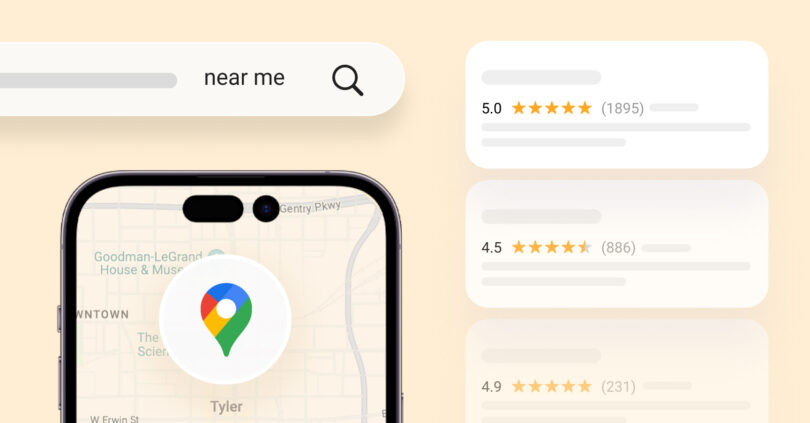
Reviews are both a local ranking factor and a conversion driver. More reviews, higher ratings, and recent review activity all contribute to your prominence score in Google’s algorithm. But beyond rankings, customers read reviews before making a decision, a 4.2-star business with 180 reviews will almost always win over a 4.8-star business with 6 reviews.
How to Get More Reviews
The most effective strategy is simple: ask. After a positive service interaction, send a follow-up email or text with a direct link to your Google review page. Most businesses that implement a systematic review request process see their review count double within 90 days.
Don’t incentivize reviews as Google’s guidelines prohibit it, and fake or incentivized reviews can get your listing penalized or suspended.
How to Respond to Reviews
Respond to every review, positive and negative. For positive reviews, a brief, genuine thank-you is enough. For negative reviews, acknowledge the issue, apologize where appropriate, and take the conversation offline. How you handle a negative review tells potential customers more about your business than the review itself.
Our Reputation Management service helps businesses monitor and respond to reviews at scale, particularly useful for agencies managing multiple client listings.
Local Content Strategy That Actually Drives Rankings
Optimizing your GBP gets you into the local pack. But ranking well for local organic results, the website listings below the map requires a solid content strategy built around local intent.
Location Pages
If you serve multiple cities or neighborhoods, create a dedicated page for each one. A roofing company serving Dallas, Plano, and Frisco should have three separate location pages, each with unique content about that specific area. Don’t just swap the city name in a template, write genuinely useful content for each location.
Locally Relevant Blog Content
Blog content that addresses local topics builds topical relevance and earns local links. A dentist in Chicago might write a guide to dental insurance providers commonly used in Illinois, or cover news about local health initiatives. This type of content attracts local links naturally and reinforces your geo-relevance.
Our Blog Content service and Topical Map Strategy can help you build a content structure that supports long-term local ranking authority.
Schema Markup for Local Businesses
Add LocalBusiness schema to your website. This structured data helps Google understand your business type, location, hours, and contact details at a technical level. It can also improve how your website appears in rich results. Use Google’s Rich Results Test tool to validate your schema after implementation.
Internal Linking
Link your location pages and local blog content to each other logically. If someone lands on your “Plano roofing” page, link to your blog post about storm damage repair in North Texas. This keeps users engaged and passes link equity between your most important local pages.
AI’s Impact on Local Search in 2026
AI is reshaping how people find local businesses. Google’s AI Overviews now appear for many local queries, surfacing synthesized answers from across the web before traditional results. Voice assistants and tools like Perplexity are also answering local queries with AI-generated responses.
What This Means for Local Businesses
If your business information isn’t clearly structured and consistent across the web, AI systems may not surface your business accurately or at all. AI pulls from your GBP data, your website, your citations, and your reviews to form an understanding of who you are and what you offer.
Businesses that invest in comprehensive GBP optimization, consistent citations, and quality reviews are naturally better positioned for AI-driven local results because AI relies on the same signals Google’s traditional algorithm does.
Structured Data Becomes More Critical
With AI Overviews pulling information to generate answers, structured data helps AI systems parse your content accurately. LocalBusiness schema, FAQ schema on your location pages, and Review schema all contribute to how AI interprets and represents your business.
Conversational Queries Are Growing
People are asking longer, more conversational questions: “What’s the best family dentist near downtown that takes Delta Dental on a Saturday?” Your content and GBP attributes need to reflect the specifics people are searching for accepted insurance, hours, parking, accessibility features. The more attributes you fill in on your GBP, the better you match conversational queries.
Multi-Location SEO Strategies
Managing local SEO for multiple locations is a different challenge from managing a single location. The core principles are the same, but the execution requires structure and consistency at scale.
Separate GBP Listings for Each Location
Each physical location needs its own Google Business Profile. Each listing should have location-specific photos, hours, and a unique phone number. Avoid using the same phone number across multiple listings, it creates confusion for both Google and customers.
Unique Location Pages on Your Website
Every location needs its own page with genuinely unique content. Duplicate location pages with only the city name swapped are a common mistake that triggers thin content issues. Include location-specific details: the address, team members at that location, local landmarks, community involvement, and unique services offered there.
Consistent Citation Profiles for Each Location
Build citation profiles for each location separately. The NAP for Location A and Location B must be distinct and consistent across all directories. Tools like BrightLocal help manage this at scale.
Centralized Review Management
Set up a system to monitor reviews across all locations from a single dashboard. Respond promptly and consistently. A missed review on your third-busiest location can still damage overall brand trust.
If you’re an agency managing local SEO for multiple clients or a business with multiple branches, our Monthly SEO Plans are designed to handle this level of complexity efficiently.
Common Mistakes to Avoid
Even experienced marketers make these errors. Fixing them can produce quick ranking improvements.
Keyword stuffing your business name: Adding keywords to your GBP business name (e.g., “Mike’s Plumbing – Best Plumber Dallas”) violates Google’s guidelines and can get your listing suspended. Use your real business name only.
Ignoring duplicate listings: Duplicate GBP listings confuse Google and split your ranking signals. Search for your business on Google Maps and merge or report any duplicates you find.
Setting up location pages as near-duplicates: Thin location pages that just swap city names are a waste of crawl budget and won’t rank. Invest in genuinely unique content for each page.
Not updating GBP for holiday hours: Google prominently displays “Hours may differ” warnings when holiday hours aren’t set. That warning reduces customer confidence and clicks.
Neglecting off-page signals: Many businesses focus entirely on GBP and ignore backlinks. Links from local news sites, chambers of commerce, and industry directories significantly boost prominence. Our Foundational Backlinks and Blogger Outreach services address this directly.
Tools for Local SEO in 2026
Here are the tools used by serious local SEO practitioners:
| Tool | Primary Use | Best For |
|---|---|---|
| Google Business Profile Manager | GBP management | All businesses |
| BrightLocal | Citation audits, rank tracking | Agencies, multi-location |
| Whitespark | Citation building, review tracking | Local businesses |
| Semrush | Keyword research, competitive analysis | All |
| Ahrefs | Backlink analysis, content gaps | Intermediate to advanced |
| Moz Local | NAP consistency, citation management | Small to mid-size businesses |
| Google Search Console | Indexing, performance data | All businesses |
Don’t pay for every tool at once. For most businesses starting out, Google Business Profile Manager + BrightLocal + Google Search Console covers 80% of what you need to execute a solid local SEO strategy.
Frequently Asked Questions
How long does local SEO take to show results?
Most businesses see meaningful movement in local pack rankings within 3 to 6 months of consistent optimization. Citation building and review acquisition tend to produce faster results than organic content, which takes longer to build authority. Competitive markets take longer, a plumber in Manhattan will take longer to rank than one in a smaller city.
What is the most important factor for ranking in the local pack?
There’s no single most important factor, but Google Business Profile completeness and accuracy, combined with review volume and rating, tend to have the most immediate impact. Prominence built through backlinks, citations, and reviews is the factor businesses most often neglect and the one that most separates top-ranked businesses from the rest.
Does my website matter for local SEO?
Absolutely. Your website reinforces everything your GBP signals. On-page optimization for local keywords, local content, schema markup, and website authority all feed into your local rankings. A well-optimized GBP with a weak website will plateau. For strong results, both need attention.
How do I rank in a city where I don’t have a physical address?
This is genuinely difficult. Google’s local pack is heavily proximity-based. If you serve an area but don’t have an office there, focus on organic rankings instead of the map pack. Create a dedicated, in-depth location page for that city, build local links from that area, and earn mentions in local media. Some service-area businesses also rent coworking spaces to establish a legitimate address, but only do this if you’ll actually serve customers there.
How many Google reviews do I need to rank well?
There’s no fixed number, but in most markets you need to be competitive with the top-ranked businesses in your category. Check your top local competitors’ review counts and use that as a benchmark. Recency matters too,10 new reviews this month signals more to Google than 50 reviews from three years ago with nothing recent.
Should I respond to negative reviews?
Yes, always. Responding to negative reviews professionally demonstrates that you value customer feedback and take problems seriously. Google’s guidelines encourage engagement with reviews. More importantly, your response is public, potential customers will read it and form an opinion of your business based on how you handled the complaint.
What is NAP consistency and why does it matter?
NAP stands for Name, Address, and Phone number. Consistency means your business information is identical across every directory, citation, and web mention. Inconsistencies signal to Google that your business data is unreliable, which suppresses local rankings. It’s one of the most common and most fixable local SEO issues.
How does AI affect local SEO in 2026?
Google’s AI Overviews, voice search, and AI-powered assistants increasingly answer local queries directly. Businesses with fully optimized GBP listings, consistent citations, rich structured data, and strong review profiles are best positioned to appear in these AI-generated answers. The signals AI relies on are largely the same signals traditional local SEO has always focused on.
Key Takeaways
Local SEO in 2026 rewards businesses that treat it as an ongoing discipline, not a one-time setup. Here’s what to focus on:
- Google Business Profile is your most powerful local ranking tool, keep it fully optimized, active, and accurate
- NAP consistency across all citations removes friction in Google’s ability to trust and rank your business
- Reviews drive both rankings and conversions build a systematic process for earning and responding to them
- Local content on your website strengthens your organic presence and supports the authority that lifts your map pack rankings
- AI search isn’t replacing local SEO fundamentals, it’s amplifying them. Structured data and consistent information matter more than ever.
If you’re ready to turn local search into a consistent lead generation channel, the team at 7th Club can help. Our Local SEO service is built for businesses and agencies that want real results, not vanity metrics. We also offer Monthly SEO Plans, Business Citations, Reputation Management, and Blogger Outreach for comprehensive local search coverage.