
Topical Authority SEO 2026: Proven Steps to Lead Your Niche
You can publish 50 blog posts and still rank for nothing. Sound familiar?
The problem usually isn’t your writing quality or even your backlinks. It’s that Google doesn’t see you as an authority on anything specific. You’re covering too many topics too shallowly, and Google’s algorithm notices.
Topical authority SEO fixes that. It’s the practice of building such comprehensive, well-structured coverage of a subject that Google treats your site as the go-to resource, the way it treats Healthline for medical questions or Investopedia for finance.
In this guide, you’ll learn exactly how to build topical authority SEO from scratch: the content models behind it, how to map your topics, how internal linking amplifies it, and how to measure whether it’s actually working.
What Is Topical Authority in SEO?
Topical authority is Google’s assessment of how comprehensively and reliably your website covers a specific subject area. It’s not just about having one great article. It’s about having a body of content that signals deep expertise across all angles of a topic.
Think of it this way: if you search for “how to treat a sprained ankle,” Google isn’t just looking for a page with those exact words. It’s looking for a source that has also covered related subtopics like ankle anatomy, rehabilitation exercises, when to see a doctor, and how to tape an ankle. That interconnected depth is topical authority.
Google’s Helpful Content system and E-E-A-T guidelines (Experience, Expertise, Authoritativeness, Trustworthiness) both reward this kind of subject-matter depth. According to Google’s Search Quality Rater Guidelines, evaluators are specifically asked to assess whether a site is a recognized authority on the topic it covers.
The practical implication: building topical authority means you don’t just rank for one keyword. You rank for clusters of related keywords simultaneously, because Google trusts your entire domain when assessing new pages you publish.
Why Topical Authority Matters
SEO has changed significantly over the past few years, and topical authority SEO has moved from a nice-to-have to a fundamental ranking requirement. Here’s why.
AI Overviews have compressed the SERP. With Google’s AI-generated answers now appearing above traditional results, only the most authoritative sources get cited. Ahrefs data from 2025 shows that pages cited in AI Overviews have significantly higher topical depth scores than pages that rank on page one but don’t get cited. Being authoritative isn’t just about ranking anymore; it’s about being referenced by AI.
Google’s Helpful Content updates punished thin-coverage sites. Sites that published dozens of loosely related articles without a coherent topical strategy lost 30-60% of their organic traffic during the 2023-2024 core updates. Sites with deep, structured topical coverage recovered fastest.
Zero-click searches reward brand visibility. Even when users don’t click your result, appearing consistently for a topic cluster builds brand recognition. That recognition influences future searches, turning passive awareness into direct traffic over time.
Your competitors are already doing this. In competitive niches, the sites dominating page one aren’t just well-optimized individual pages. They’re entire content ecosystems built around topical clusters.
The Topic Cluster Model
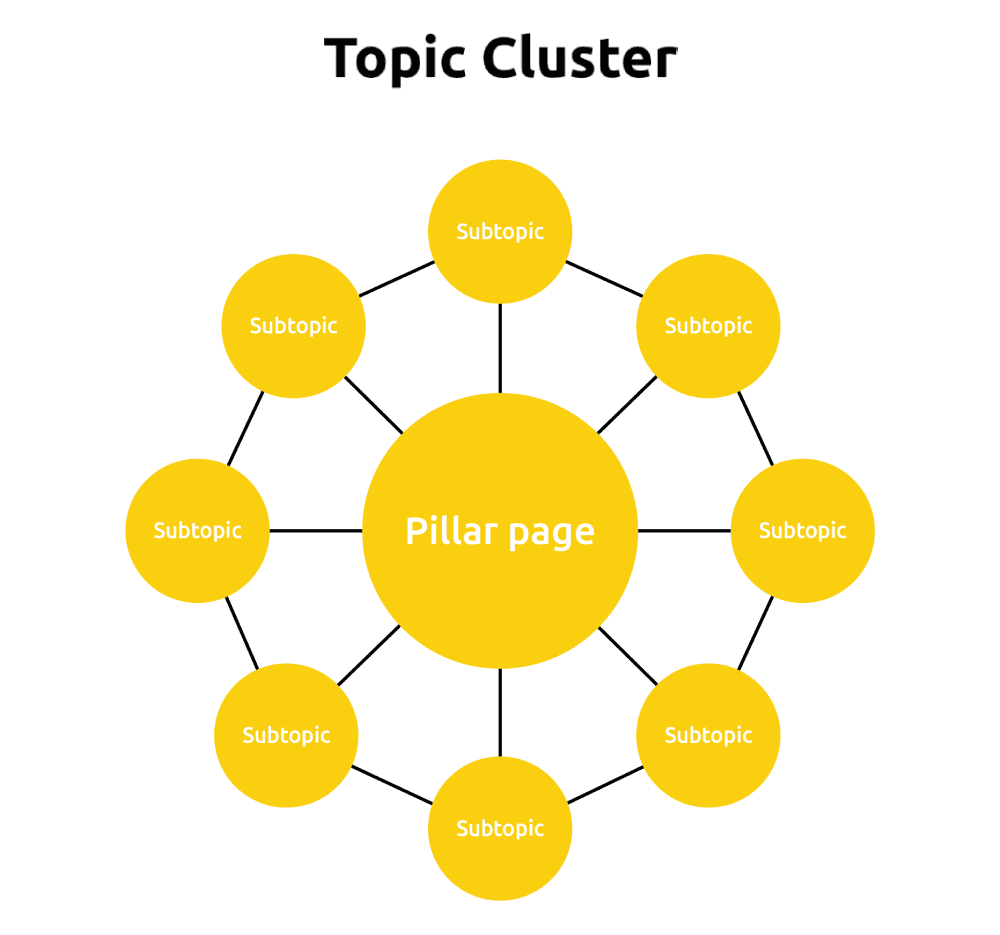
The topic cluster model, popularized by HubSpot’s research team around 2017 and now validated by years of real-world results, is the structural backbone of topical authority SEO.
It works like this: instead of publishing independent articles on loosely related topics, you organize your content into three interconnected layers.
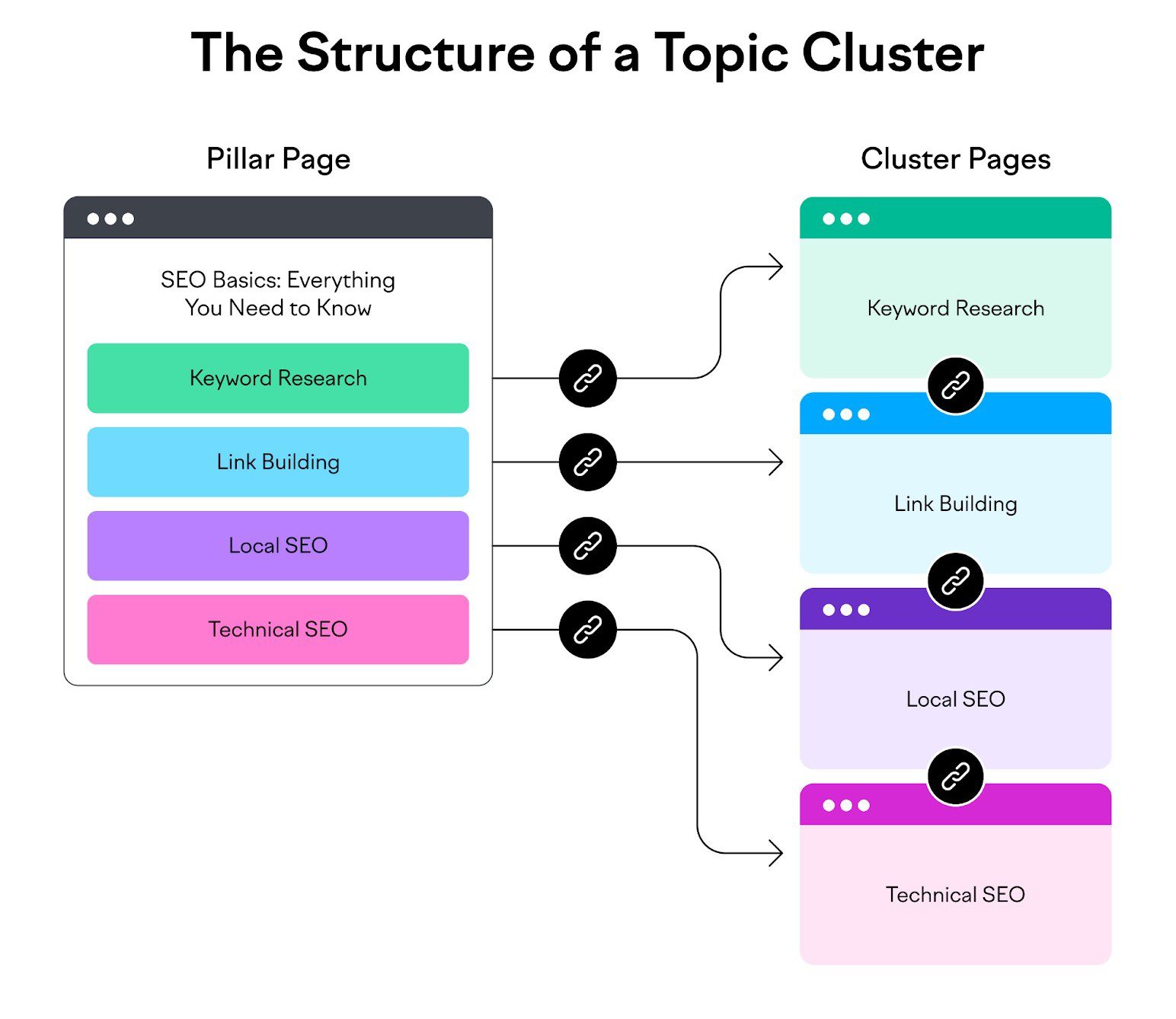
The Pillar Page sits at the center. It’s a comprehensive, long-form page (typically 3,000-6,000 words) that covers a broad topic at a high level. Think “The Complete Guide to Email Marketing” or “Everything You Need to Know About Technical SEO.” It doesn’t go deep on every subtopic; it introduces each one and links out to cluster pages that do.
Cluster Content Pages are focused, in-depth articles that cover individual subtopics from the pillar in detail. If your pillar is about email marketing, your clusters might include subject line optimization, email list segmentation, A/B testing campaigns, and email deliverability. Each cluster page links back to the pillar and ideally to other relevant cluster pages.
Internal links are the connective tissue. They tell Google that all these pages belong to the same topical ecosystem, allowing authority to flow between them.
The result is a content architecture that mirrors how experts actually think about a subject. Google’s natural language processing models recognize this coherence and reward it with rankings across the entire cluster.
One practical note: you don’t need hundreds of articles to start. A pillar page supported by 8-12 well-written cluster pages is enough to begin building authority in most niches.
How to Build Pillar Pages That Actually Work
A pillar page isn’t just a very long blog post. It has a specific structure and purpose that sets it apart from regular content.
Start with keyword intent mapping. Your pillar page should target a broad, high-volume head term (like “content marketing” or “link building”). Use tools like Ahrefs or SEMrush to identify the main keyword and all its semantic variations. These variations should appear naturally throughout the pillar.
Cover every major subtopic. Use Google’s “People Also Ask” boxes, related searches, and competitor outlines to ensure you’re not missing important angles. A pillar page that answers only some of the questions users have about a topic won’t build authority. Think of it as the definitive starting point for anyone new to the subject.
Keep each subtopic section concise but complete. You’re not writing a full tutorial on each subtopic (that’s what cluster pages are for). You’re giving enough context that a reader understands the concept and has a clear path to learn more by clicking through to the dedicated cluster page.
Optimize for featured snippets and AI citation. Structure your definitions and explanations so they can be pulled directly into featured snippets. Use clear headings (H2 and H3), concise definitions in the first sentence of each section, and tables or lists where appropriate. This formatting also increases your chances of appearing in Google AI Overviews.
Update regularly. A pillar page is a living document. Add new subtopics as your cluster grows. Update statistics and examples. Google rewards freshness, especially for competitive topics.
Content Mapping: Planning Your Way to Authority
Content mapping is the process of planning your entire topical ecosystem before you start writing. It prevents the random publishing that kills most content strategies.
Here’s a practical process you can follow:
Step 1: Choose your core topic. Pick a subject directly tied to your business and your audience’s needs. Be specific enough to realistically compete. “Digital marketing” is too broad for most sites. “Local SEO for service businesses” is actionable.
Step 2: Identify your pillar keyword. This is the broad term at the center of your cluster. It should have significant search volume (typically 1,000+ monthly searches) and represent something your ideal customer genuinely wants to understand.
Step 3: Brainstorm all subtopics. List every question, concern, process, and concept someone would need to understand to master your core topic. Don’t filter yet. Aim for 30-50 potential subtopics.
Step 4: Group and prioritize. Cluster your subtopics into logical groups. Identify which ones have dedicated search demand (use Ahrefs Keyword Explorer or SEMrush to check monthly search volumes). Prioritize the ones with both search volume and direct relevance to your business.
Step 5: Assign content types. Not every subtopic needs a 2,000-word blog post. Some might be better as quick FAQ entries within the pillar page, comparison tables, or short explainer videos. Match the format to the intent.
Step 6: Build your editorial calendar. Plan your publishing sequence. Start with your pillar page, then publish cluster pages systematically over 3-6 months. Consistency signals to Google that you’re actively building expertise.
Entity-Based SEO and Semantic Search
Google doesn’t just read words; it understands entities: the people, places, brands, concepts, and relationships that exist in the real world. Building topical authority SEO now requires thinking in entities, not just keywords.
An entity in SEO terms is anything Google’s Knowledge Graph recognizes as a distinct, real-world object or concept. “Search Engine Optimization,” “Google,” “Backlink,” and “Core Web Vitals” are all entities. When your content clearly discusses entities and the relationships between them, Google’s natural language processing models can accurately categorize your site.
Here’s why this matters for topical authority: Google’s algorithms assess whether your content covers the right entities for a given topic. A page about email marketing that mentions entities like “open rate,” “click-through rate,” “A/B testing,” “ESP” (email service provider), and “email deliverability” will be understood as a genuinely authoritative resource. A page that just repeats the target keyword without engaging these associated entities won’t.
Practical steps for entity optimization:
- Research the key entities in your niche using tools like Google’s Knowledge Panel, Freebase, or simply studying what Wikipedia covers on your topic.
- Include entity-rich language naturally in your content. Don’t force it, but don’t avoid technical terminology either.
- Use Schema markup (structured data) to explicitly identify entities on your pages. Article, FAQ, HowTo, and Organization schemas are particularly useful for topical authority SEO.
- Build your brand as an entity. Your company name, logo, and “About” information help Google establish your site as a known, trusted entity, which in turn boosts E-E-A-T signals.
Internal Linking Strategies for Topical Authority
Internal linking is one of the most underused levers in SEO, and it’s essential to making your topic cluster strategy work.
When you link from a cluster page back to your pillar, and from the pillar out to clusters, you’re doing two things: helping users navigate your content ecosystem, and signaling to Google which pages are most important and how they relate to each other.
The hub-and-spoke model is the foundation. Your pillar page (hub) links to every cluster page (spoke). Every cluster page links back to the pillar. This concentrates topical signals and passes PageRank through the cluster.
Cross-link between cluster pages where it’s genuinely helpful. If your “email subject lines” cluster page naturally connects to your “A/B testing emails” page, link between them. Don’t force connections, but don’t miss obvious ones either.
Use descriptive anchor text. “Click here” and “read more” are wasted opportunities. Use keyword-rich, descriptive anchor text like “email deliverability best practices” or “how to build backlinks for local businesses.” This reinforces the topical relationship between pages.
Audit your internal links regularly. As your content grows, older pages may not link to newer, more relevant cluster content. Tools like Screaming Frog or Ahrefs’ Site Audit can surface pages with few or no internal links (often called “orphan pages”), which are a common drain on topical authority.
Link depth matters. Important cluster pages should be reachable within 2-3 clicks from your homepage. Pages buried 5+ clicks deep receive less crawl attention and authority flow.
Our Monthly SEO Plans include ongoing topical authority SEO building as a core service, with content planning, cluster development, and performance tracking built into every engagement.
How to Measure Topical Authority SEO
Topical authority isn’t a single metric you can read from a dashboard. But you can track it through a combination of signals that, together, tell a clear story.
Keyword coverage and ranking spread. Pull all the keywords your site ranks for in Ahrefs or SEMrush. Group them by topic. If you’re building authority in a cluster, you should see rankings expanding across more subtopic keywords over time, not just fluctuating on one primary keyword.
Average position for cluster keywords. Track the average SERP position for all keywords within a topic cluster. Consistent improvement across the cluster (not just isolated pages) is a sign your topical authority SEO is growing.
Organic click-through rate trends. As your brand becomes more recognized in a niche, your CTR for branded and semi-branded queries improves even when your average position stays the same. This signals growing authority and trust.
Topical depth scores. Tools like Clearscope, Surfer SEO, and MarketMuse offer content scoring that compares your pages’ entity coverage against top-ranking competitors. If your scores are consistently rising closer to (or above) competitors, you’re building real semantic authority.
AI Overview citations. Manually track whether your pages are being cited in Google’s AI Overviews for target keywords. This is one of the clearest signals that Google considers you authoritative enough to include in its generated answers.
Branded search volume. Track your brand’s search volume over time via Google Search Console. Rising branded searches indicate that your content is creating awareness and trust beyond individual SERP clicks, a key long-term benefit of topical authority SEO.
Common Mistakes That Kill Your Authority
Even with the right strategy in place, these mistakes regularly derail topical authority SEO efforts.
Publishing too broadly. Trying to cover ten different topic clusters simultaneously dilutes your authority in all of them. Pick one or two core topics and go deep before expanding.
Ignoring content quality in favor of volume. Publishing 30 thin, 500-word articles won’t build authority. It might actually hurt it after Google’s Helpful Content system evaluates your site. Ten well-researched, comprehensive cluster pages beat 30 shallow ones every time.
No pillar page to anchor the cluster. Some sites publish great cluster content but never create the central pillar that ties it together. Without the pillar, Google sees a collection of loosely related articles, not a coherent topical ecosystem.
Orphaned content. Publishing cluster pages without linking them to the pillar (or each other) means their authority never flows through the cluster. Always build your internal link structure at the time of publishing, not as an afterthought.
Inconsistent publishing. Topical authority builds over months, not weeks. Sites that publish intensively for 60 days and then stop rarely see sustained authority gains. A consistent pace (even one well-researched piece per week) outperforms unpredictable bursts.
Ignoring content updates. Old cluster pages with outdated statistics or stale examples erode trust. Schedule quarterly reviews of your most important pages and update them with fresh data.
FAQs
How long does it take to build topical authority SEO?
Most sites begin seeing measurable ranking improvements within 3-6 months of implementing a topic cluster strategy consistently. Full topical authority SEO in a competitive niche typically takes 12-18 months of sustained content development. The timeline shortens if you already have some relevant content that can be restructured into clusters.
How many cluster pages do I need per pillar?
A minimum of 8-10 cluster pages per pillar is generally enough to signal topical depth to Google. More competitive topics may require 15-25 cluster pages. Focus on covering every meaningful subtopic your audience searches for rather than hitting an arbitrary number.
Is topical authority more important than backlinks?
They work together, not against each other. Topical authority SEO helps Google understand what you’re an expert in. Backlinks signal how trusted you are. Sites with strong topical authority and even moderate backlink profiles regularly outrank sites with more backlinks but shallow content. According to Ahrefs’ content analysis, pages with deep topical coverage attract more natural links over time anyway, making the two strategies mutually reinforcing.
Can a new website build topical authority SEO quickly?
Yes, new sites can build topical authority SEO faster than you might expect by starting with a tight, well-defined niche. Instead of competing broadly, focus on a specific subtopic where there’s real search demand but less competition. Build your full cluster in that niche before expanding. New sites that launch with 10-15 well-structured cluster pages often see their first significant rankings within 60-90 days.
Does topical authority help with AI search (ChatGPT, Perplexity)?
Absolutely. AI search engines like Perplexity and Google’s AI Overviews rely on the same underlying signals that traditional SEO rewards: authoritative, well-structured, entity-rich content. Sites with strong topical authority SEO are disproportionately cited in AI-generated answers because these systems are designed to pull from trusted, comprehensive sources.
What tools should I use to build topical authority?
The most useful tools include Ahrefs or SEMrush for keyword and competitor research, Surfer SEO or Clearscope for content optimization against topical depth benchmarks, Screaming Frog for internal link auditing, and Google Search Console for tracking rankings and coverage growth. Koala, MarketMuse, and similar AI tools can help with content gap analysis.
Do I need a separate pillar page for every topic?
Yes, each major topic cluster should have its own dedicated pillar page. Trying to combine two distinct topics into a single pillar creates confusion for both readers and Google. Keep each pillar tightly focused on one core subject with its own URL.
Wrapping Up
Building topical authority SEO isn’t a shortcut strategy; it’s a compounding investment. Every cluster page you publish strengthens the pillar, and every strengthened pillar lifts your entire cluster. Done consistently, it’s one of the most durable competitive advantages available in organic search.
Here’s what to take away from this guide:
- Structure beats volume. A well-organized cluster of 12 connected pages outperforms 50 isolated blog posts.
- Start narrow, go deep. Pick one core topic, dominate it, then expand.
- Internal linking is non-negotiable. Without it, your cluster pages never realize their full potential.
- Entity coverage signals expertise. Write for people, but don’t avoid the technical vocabulary that proves your expertise to Google.
- Measure the whole cluster, not just individual pages. Track ranking spread, average position by topic, and AI citation frequency.
Your next step: audit your existing content. Identify which topics you’ve touched but not fully developed. Pick one, build your pillar, map your cluster gaps, and start filling them in systematically.
If you’d like a hand building your topical authority SEO strategy from the ground up, explore our SEO services at 7th Club or reach out for a free consultation. We’ve helped brands across competitive niches build content ecosystems that rank, convert, and compound over time.